From link::roryseiter.blogspot
Four hours North of Chiang Mai lies the small village of Pai. It consists mostly of guesthouses and restaurants. A few years ago there were no ATMs, dirt roads, and sleepy locals. Then people like us arrived. We arrived by the thousands. Walking down the streets was like walking through a small Hawaiian town. There were stalls selling anything that you could want. Music was playing out of everywhere, Red Hot Chili Peppers, Bob Marley, and Jack Johnson. 

Every morning, Pai is blanketed in a cold mist. The people of Pai dress as if they are living at Everest base camp. Nepalese looking hats, scarves, gloves are all common in Pai. As the sun makes its entry, it slowly burns off the mist and the days get pretty warm.
Little did we know that we would be arriving in Pai for the biggest event of the year, the “Pai Music Celebration”. This was a festival that was a Vans Warped Tour, country fair, and swap meet all in one. Entry fee = about $1. There was a small stage with a local band playing Thai rock music. Then there was a big stage of a Thai band playing Bob Marley covers. 


There isn’t much to do in Pai, but that is the appeal. The most popular things are trekking, elephant riding, and white water rafting. The trekking consisted of overnight camping for a couple days and we were only there for one night. The white water rafting was in a river that looked toxic. Brown and slow moving wasn’t appealing, so we opted for the elephants. Very happy that we did!

From link::roryseiter.blogspot
Other links::Nina the Lone Explorer!
About Pai - Thailand
5/08/2008
Do nothing in Pai
UtoPai
From link::2headedturtle.wordpress

They’ve got Bird Flu in Vientiane: a woman and a young girl died recently. Chickens are generally to be avoided there: Much of our time in Laos was spent barely avoiding them as they dashed across the roads.
The presence of Bird Flu may in fact explain the psychology of the suicidal road chicken, a common phenomenon across SE Asia. These silly birds dart across the road as traffic approaches, usually barely avoiding rubber in their determination to get to the other side. Why? Are they sick, depressed?
How bad, I wonder, is the incidence of suicide among Burmese chickens, now that Bird Flu has again broken out in Myanmar?
The chickens were healthy and not the least depressed in Pai, in northern Thailand, where we spent a few days (too few) before returning to Bangkok. A much greater concern in Pai is the Westerner on a motorbike.
The sidewalk eateries of Pai’s main streets are lined not with chickens awaiting the worst moment to cross a crowded street, but with wounded white people nursing bandaged heads and arms in slings, trying with difficulty to see their breakfasts through puffy, bruised eyes. A reminder of the dangers of navigating the roads and alleys in an alien driving environment – if we needed any reminder after six weeks in this motorbike-crazed part of the world.
It is said, though I don’t believe it, that five accidents a day occur in Pai – a town of little more than 4,000 – caused by Westerners who can’t handle their Vespas.
There are some mishaps, certainly. But the pathetic wounded notwithstanding (or standing at all) I figured there was no better time to learn to ride: Pai is a small, chilled-out town and the roads are generally open, and wide enough, all things considered. Also I’m very safe on the roads, as all who know me will agree. So we rented a motorbike one day and tooled around town, a first for us both, and had no mishaps besides once almost falling sideways off a bridge.
The countryside around Pai is normally dry this time of year, but this season the aridity has reached drought proportions. Dust and the smell of burning are everywhere. We buzzed up to a waterfall several kilometers outside of town: only a trickle of water spilled over the edge of the rock. Rafting trips, one of Pai’s chief industries, have been cancelled until rain comes – supposedly in April, but no one is confident anymore that that will happen. To the south, Chiang Mai is in a state of emergency because of the health-hazardous dust.
Zooming haphazardly around the sidewalk-like roads of Pai, ignoring the dust, was the most we accomplished in six days. We also mustered the energy to get a massage. It’s a nice town, admittedly overrun by touristic types but ideal for lazing around and eating well – and cheaply. Also for improving your talent for haggling: but all of SE Asia has honed that ability in us.
Not everywhere afforded us a chance to learn to pop wheelies down main street while scattering chickens, roti vendors and crippled Swedes.
Ha, ha. Kidding. About the Swedes.

Pai was a great place to relax after Hanoi, Land of Honking Horns. In an upcoming post we’ll tell you all about our adventures in northern Vietnam, mostly on four feet. In the meantime keep your wheels on the ground and your knees in the breeze. Like they do in Pai.
Places we recommend in Pai: Breeze of Pai Guesthouse; Na’s Kitchen (best food in town); Phu Pai, for coffee and great music nightly; and Bebop, for great atmosphere, and music, nightly.
From link::2headedturtle.wordpress
Other links::Chang Mai- Pai (Thailand)
5/07/2008
Hilltribe village tour around Mae Hong Son
From link::cactuschild.blogspot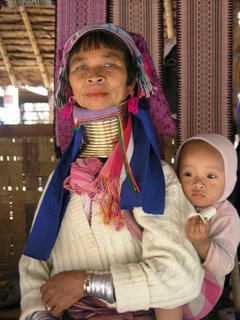
I decided upon a tour of the surrounding hilltribe villages for today, which i booked through Nam Rim tours. The company were recommended in the Lonely Planet, and the guide, Dam, seemed a very funny and knowledgeable guy with a fantastic grasp of the English language. He also knows a lot of the various Karen languages, and as he has a Kayan (longneck) girlfriend and used to work in Myanmar (where the Karen people have migrated from), we (me and a French lady called Francoise) did get a little bit of a more intimate and personal view of their lives.
Nai Soi Village
It costs 250THB to gain entry into the Karen village of Soryolay (or Nai Soi as it's more commonly known), yet only 10% of that goes to the Karen people themselves and the surrounding refugee camps. So they make their money selling handicrafts, which did give the village a very tourist-orientated feel.
The Kayan (longneck) people wear their rings from the age of around 5 or 6 years old. Some wear them on their limbs as well but most solely on the neck - hence the name 'longneck'. Contrary to belief, the rings do not stretch their necks; they depress the collarbone and ribcage, which gives the impression of the neck being unnaturally stretched. The rings around the neck can weigh up to 14kg but the normal weight of the ones worn by an adult woman is 5-6kg. The rings are only taken off 9 times in the women's lives : to change them as the collarbone and ribcage become more depressed.
The rings are worn for 3 reasons :
1.
To make the women look beautiful
2.
To warn off the interest of Thai men
3.
To distinguish them from other hilltribes
Also in the Nai Soi village live Kaya (red Karen) and Kayew (long eared Karen). There is a school in the village where the children learn Karen, Thai, Burmese and English languages. The villagers are a mixture of Buddhist and Christian religions so you will see both temples and churches existing side by side.
A great deal of time on the tour was spent in Nai Soi but we also visited a nearby Shan (Thai Yai) village which is part of the Royal Project for the King and Queen. The Shan cultivate coffee and tea and avocados in place of opium and the women spend their time making embroidery. The King and Queen have instigated the supply of electricity and fresh water to the village so that these projects can be undertaken more successfully.
Hmong Village of Huai Mae Korsom
After lunch and the best cup of coffee i've had in Thailand at the Shan village, we visited a local Hmong tribe. Their houses (made of wood or thatch) sit on the ground. Their belief system is Animism (taken from the latin word 'anima' meaning 'breath' or 'soul') and is a belief that a soul or spirit exists in every object, even if it is inanminate. Pologamy is also poermitted in the Hmong tribe, so some men have up top 4 wives.
Mae Aw
Mae Aw is 22km north of Mae Hong Son, on a mountain peak at the Myanmar border. Mae Aw is it's Chinese name, as it's a Chinese KMT settlement, but it's name has recently been changed to Ban Rak Thai (Thai loving village). There's not a lot to do here other than drink lots of tea (we tried Green, Jasmine & Udong) but the surrounding scenery is stunning.
Tham Pla (Fish Cave)
Tham Pla is a water-filled cavern in the Tham Pla National Park, where hundreds of Soro brook carp thrive. They grow to 1 metre in length and are found only in the provinces of Mae Hong Son, Ranong, Chiang Mai, Rayong, Chanthanaburi and Kanchanaburi. There's also a shrine centered around a statue of the Hindu rishi called Nara, said to protect the holy fish from danger. Just at the start of the walk up to Than Pla are several (it's difficult to tell how many as they're all entwined together) Monkey Ladders, which - until now - i never knew existed other than as a strange and interesting product you could buy from The Pier back in the UK!
Photo is of a Kayan (longneck) women with baby, Nai Soi, Nr Mae Hong Son।
From link::cactuschild.blogspot
Other links::The life of Pai
Lovepaihome
5/04/2008
Amphoe Pai - Wikipedia
Amphoe Pai
From Wikipedia, the free encyclopedia
Pai (Thai: ปาย) is the northeasternmost district (Amphoe) of Mae Hong Son Province, northern Thailand.Geography
Neighboring are (from west clockwise) Mueang Mae Hong Son, Pangmapha of Mae Hong Son Province, Shan State of Myanmar, Wiang Haeng, Chiang Dao, Mae Taeng, Samoeng and Mae Chaem of Chiang Mai Province.
The important rivers are the Pai and Khong River.
Symbols
The district slogan is Pai River, worship Luang Pho Un Mueang, spread good kind of garlic, surrounded by lush forests, way of life evenly between hot and cold.
Province:
Mae Hong Son
District office:19°21′31″N, 98°26′24″E
Area:
2,244.7 km²
Inhabitants:
29,526 (2005)
Pop. density:
13.2 inh./km²
Geocode:
5803
Postal code:
58130

5/03/2008
Travel In Pai Mae Hong Sorn Province
From link::thailand-northern.blogspot
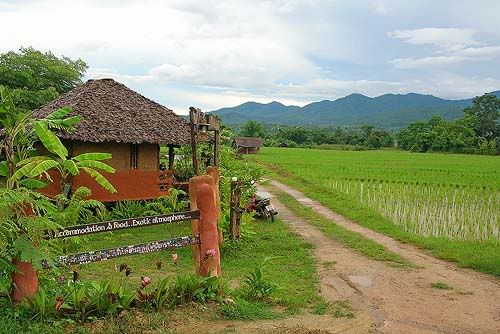
Pai district is situated about halfway between Chiang Mai and Mae Hong Sorn, the misty town on the Burmese border. At about 600 meters above sea level, surrounded by high mountains. Pai offers one of the most fertile and beautiful nature in the North of Thailand, clean air and no pollution. People from many different tribes live here peacefully together and still maintain their traditional way of living.
The serene Pai river runs from the northern border with Burma through Pai town and along virgin jungle to Mae Hong Sorn. Hardy adventurers use this route for exciting rafting.
How to get to Pai?
Start from the main tourist hub: From Chiang Mai on route 1095 towards Pai it is 132 kilometer. The bus from Chiang Mai Arcade bus station takes about 4 hours.
Buses from Chiang Mai to Pai:
7.00, 8.30, 10.30, 12.30, 16.00
Buses from Pai to Chiang Mai:
7.00, 8.30, 11.00, 12.30, 16.30
From Mae Hong Sorn town: Along this route pine trees and wild vegetation line both sides of the gently rising road passing nice scenery along the way. In Mae Hong Sorn are motorbikes and jeep available for rent.
Population of Pai
Mainly Thai Yai (from Burmas Shane state) and hill tribes (Lisu, Lahu, Karen). In town mainly Thai, Thai-Chinese, some Thai-Muslim and some foreign residents.
Occupation in Pai
Agriculture - mainly garlic, rice, fruits, lychee, cotton
Climate in Pai
Cool season: 12? C - 28? C from November - March
Hot season: 24? C - 35? C from April - June
Rainy season: 24? C - 32? C from July - September
Tourist Attractions in Pai and around
Old temples:
* Wat Nam Hu
* Wat Phra That Mae Yen (mountain temple)
* Wat Klang and Wat Luang (temples where Thai Yai / Burmese architecture is preserved)
Wonders of nature:
* Ta Pai hot spring
* Pong Duad hot spring
* Mo Paeng waterfall (near Lahu village)
* Mae Yen waterfall
* Lod caves (these are beautiful and ancient caves on a large area where graves of prehistoric civilization was found. The area is a national park with lots of different birds.
Activities in Pai
* padelling rubber boat along Pai river
* adventure rafting and canoe along Pai river
* explore caves or go mountain trekking
* elephant riding through jungle
* mountain bike cycling or motorbike-trekking (Nop's bike shop offers 2 - 3 - 4 days motorbike trekking with 250 ccm trail bikes around northern part of Mae Hong Sorn province. Guide available or on your own. Also available Honda Dream, good maps and other information.)
* jungle-treks: Pai is well known as a base camp for trekks to hill tribes. Walk through green jungle and spend the night in a hill tribe village to experience their traditional way of life. In Pai there are local or hill tribe guides and porters available.
* Herbal Sauna and Thai Traditional Massage as well as herbal medicine or Burmese Massage
* Reading (Nop's book shop)
* Thai cooking course at Peter's and Wandee's Hut in Mae Yen
Culture in Pai
Both local Thais and hilltribes still keep their traditions alive by their traditional dressing, house style, food and entertainment.
Here are some of the highlight festivals:
* Loy Kratong (full moon night in November)
* fireworks competition at Wat Luang (beginning of November)
* Kin Wo (hill tribes New Year, February)
* Thai New Year (13 - 15 April)
* bamboo throwing festival (to ask for rain, May)
Facilities in Pai
Pai is a small town but can offer enough facilities such as a post office, hospital, long distance call and fax service. Accommodations and food are good and cheap. Most of the guest houses are in town and the scenic most beautiful ones are along the river. Local restaurants and western style restaurants are available (e. g. Chez Swan Restaurant, Thai Yai Restaurant) with home made brown bread.
More Information About Pai Please visit to Thailand Online
From link::thailand-northern.blogspot
Other links::pai map


