5/03/2008

Travel In Pai Mae Hong Sorn Province

From link::thailand-northern.blogspot


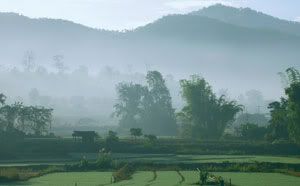
Pai district is situated about halfway between Chiang Mai and Mae Hong Sorn, the misty town on the Burmese border. At about 600 meters above sea level, surrounded by high mountains. Pai offers one of the most fertile and beautiful nature in the North of Thailand, clean air and no pollution. People from many different tribes live here peacefully together and still maintain their traditional way of living.

The serene Pai river runs from the northern border with Burma through Pai town and along virgin jungle to Mae Hong Sorn. Hardy adventurers use this route for exciting rafting.

How to get to Pai?
Start from the main tourist hub: From Chiang Mai on route 1095 towards Pai it is 132 kilometer. The bus from Chiang Mai Arcade bus station takes about 4 hours.
Buses from Chiang Mai to Pai:
7.00, 8.30, 10.30, 12.30, 16.00
Buses from Pai to Chiang Mai:
7.00, 8.30, 11.00, 12.30, 16.30
From Mae Hong Sorn town: Along this route pine trees and wild vegetation line both sides of the gently rising road passing nice scenery along the way. In Mae Hong Sorn are motorbikes and jeep available for rent.
Population of Pai
Mainly Thai Yai (from Burmas Shane state) and hill tribes (Lisu, Lahu, Karen). In town mainly Thai, Thai-Chinese, some Thai-Muslim and some foreign residents.
Occupation in Pai
Agriculture - mainly garlic, rice, fruits, lychee, cotton
Climate in Pai
Cool season: 12? C - 28? C from November - March
Hot season: 24? C - 35? C from April - June
Rainy season: 24? C - 32? C from July - September
Tourist Attractions in Pai and around
Old temples:
* Wat Nam Hu
* Wat Phra That Mae Yen (mountain temple)
* Wat Klang and Wat Luang (temples where Thai Yai / Burmese architecture is preserved)
Wonders of nature:
* Ta Pai hot spring
* Pong Duad hot spring
* Mo Paeng waterfall (near Lahu village)
* Mae Yen waterfall
* Lod caves (these are beautiful and ancient caves on a large area where graves of prehistoric civilization was found. The area is a national park with lots of different birds.

Activities in Pai
* padelling rubber boat along Pai river
* adventure rafting and canoe along Pai river
* explore caves or go mountain trekking
* elephant riding through jungle
* mountain bike cycling or motorbike-trekking (Nop's bike shop offers 2 - 3 - 4 days motorbike trekking with 250 ccm trail bikes around northern part of Mae Hong Sorn province. Guide available or on your own. Also available Honda Dream, good maps and other information.)
* jungle-treks: Pai is well known as a base camp for trekks to hill tribes. Walk through green jungle and spend the night in a hill tribe village to experience their traditional way of life. In Pai there are local or hill tribe guides and porters available.
* Herbal Sauna and Thai Traditional Massage as well as herbal medicine or Burmese Massage
* Reading (Nop's book shop)
* Thai cooking course at Peter's and Wandee's Hut in Mae Yen

Culture in Pai
Both local Thais and hilltribes still keep their traditions alive by their traditional dressing, house style, food and entertainment.
Here are some of the highlight festivals:
* Loy Kratong (full moon night in November)
* fireworks competition at Wat Luang (beginning of November)
* Kin Wo (hill tribes New Year, February)
* Thai New Year (13 - 15 April)
* bamboo throwing festival (to ask for rain, May)

Facilities in Pai
Pai is a small town but can offer enough facilities such as a post office, hospital, long distance call and fax service. Accommodations and food are good and cheap. Most of the guest houses are in town and the scenic most beautiful ones are along the river. Local restaurants and western style restaurants are available (e. g. Chez Swan Restaurant, Thai Yai Restaurant) with home made brown bread.

More Information About Pai Please visit to Thailand Online

From link::thailand-northern.blogspot


Other links::pai map

Chiang Mai -water festival

Hippyland, Thailand

From link::therangelife.wordpress

If you’re wondering where all the hippies went after Jerry Garcia died, I found them here in Pai, Thailand.

Well, that’s a little unfair. Marjan (the Dutch woman I met in Chiang Mai) and I did, after all, *just* get here after a hot, cramped, torturous, and lovely 4-hour bus ride from Chiang Mai. So before I blurt out any more ill-informed opinions about Pai, why don’t I recount what I’ve been up to.

When I last left you, I was in Chiang Mai at the beginning of 3 straight days of being soaking wet whilst celebrating Songkran, which is the Thai new year. Chiang Mai is Thailand’s “other” city - they say that while it has a slightly more northern Thai feel (in terms of architecture, food, and ethnic groups), its smaller population and more laid-back attitude allows visitors to experience to real Thailand without the struggle that characterizes doing so in Bangkok. All that said, I still don’t really know what Chiang Mai is like, because the city was shut down and turned into Water World for Songkran.

My first night in CM (Saturday) I had stayed at The Royal Guest House, which is outside the old city. Sure, it had a small pool and internet on the premises. And for a mere 300 baht (around $9.75) I was given the privilege of walking up 5 flights of stairs to a run-down room with no air-con, no hot water, no towel and no toilet paper. Gah.

In the morning (Sunday) I tried to avoid the water wars by visiting various Wats (Buddhist temples) around town. Wat Phra Singh, the main temple in the old city, was surrounded by people selling food and drink to worshipers (or followers?) who spent the day picnicking, listening to talks by monks, and watching what appeared to be hilarious, aggressively amplified amateur theater played on a makeshift stage. I escaped the shrill actors’ voices by returning to the streets, where I was greeted with buckets of Songkran cheer. I wove down side streets back to my guest house to drop off my bag (so my stuff wouldn’t get soaked) and joined in the fun.

That night I switched guest houses to Eagle House 2, where for 200 baht ($6.50) I got similar conditions but without the 5 flights or the attitude. I chose it because it’s friendly, centrally located in the old city, and it has a good reputation for organized treks to visit hill tribes in the surrounding area. I neglected to realize that in this case “centrally located” meant “sounds like the crappy cover band at the bar next door is actually playing in your bathroom.” So I was serenaded by some Thai dude’s renditions of hits by The Grateful Dead, Oasis, Nirvana, The Allman Brothers, etc. until around 1:30 am. At least the music distracted me from the sagging bed frame.

So while I haven’t been tremendously successful in getting sleep, I have been having fun. On Monday I joined a 2-day, 1-night trek organized through Eagle House to visit some villages of the Karen tribe. There were 11 of us: our guide, named Doh (heh heh); Boom (really!), the schlepper/sherpa-like guy who carried our food; Allison, a Canadian living in Bangkok and teaching Thai children at an international school; Roberta and Greg, Allison’s parents visiting from Montreal; Sam and Lisa, a lovely couple from York, England, who were on month 10 of their year-long trip around the world (again, I feel like a travel-schmuck); Cami (from Texas) and Sara (from Ohio), friends who had just finished their TOEFL teaching certification in Phuket; and then Matt, an Aussie with a British passport (or Brit with an Aussie accent?) who was in the midst of an existential crisis. He regaled us (so to speak) with conspiracy-like theories about pharma companies and the Aussie government, his hatred of capitalism and greed, the true secrets of life (there are many) and many, many, many other things.

There’s a ton to write about the trek, but right now I’m starving so I’m off to grab a bite. Also, this internet cafe lets you upload photos, so I’m hoping to add a few thousand words’ worth later today.


From link::therangelife.wordpress


Other links::Bye Pai

Pai In The Sky


Bye Pai

From link::therangelife

Just came back from a day riding around the countryside on a motorbike for most of the day. Beautiful, but hot and exhausting. For lunch we went to Sipsongpanna, a place in the village of Wiang Nur that Chris, Howie’s friend, recommended. Deelicious Thai vegetarian food, if you ever get up this way (and if you can find it!).

Yesterday Marjan and I took a Thai cooking class at Pai Cookery School. The proprietor, Gaew, was extremely gracious, knowledgeable, and patient (especially when we decided we wanted to customize the menu a bit). The class included a trip to the local market, where she told us about Thai ingredients and dishes other than what we were making. The market sells everything from papaya to roasted cicadas and various other bugs. Which reminds me - I neglected to mention that I *tried* a roasted cicada during my trek last week. (I removed the head before eating - I couldn’t bear the eyeballs.) It was…salty and crunchy and I got little legs caught in my teeth. I shan’t eat them, unless I’m under great duress.

In the evening after class we met up with Chris. We tried to meet at a bar, but they were all closed last night - no place was allowed to sell alcohol (though the markets still sold bottles) because today is election day, and the government figures if people drank they wouldn’t get up to go to the polls. That’s a new one for me.

Anyway, instead we went to a local bakery and Chris told us about his 4 years living in Pai, and how much it’s changed. Definitely interesting to hear about the place from an adopted local!

So tomorrow morning I’m on a 7am mini bus back to Chiang Mai, then on a plane down to Phuket, where the nice people at Similan Diving Safaris are sending a taxi to pick me up and bring me to them in the town of Khao Lak, on the Andaman coast. They’re even going to help me find a guesthouse nearby for Monday & Tuesday nights. Then on Wednesday I’m off on a 4-day, 4-night dive trip on the M/V Dolphin Queen to the Similan Islands, Surin Islands, Koh Bon, and Richelieu Rock. YEAH.


From link::therangelife


Other links::Pai (but no pie in sight!)

More Wildlife Wanderings in Pai

Pai

From link::Pai

Pai
(ปาย) is a small town (pop. 3000) in North Thailand, between Chiang Mai and Mae Hong Son on Route 1095. The surrounding district is Amphoe Pai. Both are named after the Pai River.

Understand

Pai is a predominantly tourism-oriented town, offering a relaxed atmosphere with a broad traveller & backpacker scene. In early 2006 a sudden boom in guest-house and bar construction has resulted in a great deal of spare capacity - capacity that is partially taken up by an increase in Thai people visiting after Pai was featured in a romantic Thai film.

By road

Route 1095 which connects Pai with Mae Hong Son (50km as the crow flies, but approx. 110km by road) and Chiang Mai (135km) is a very scenic route through the mountains which takes several hours (but worth it). It's a steep and windy drive, with lots of curves, so take a plastic bag and some motion-sickness pills if you need them.

By motorcycle

Route 1095 isn't as bad as people make it out to be. There isn't much traffic and you can hear the cars and trucks coming. If you're a little adventurous, rent a motorcycle in Chiang Mai and make the ride up to Pai. You can stop at the waterfalls and small towns along the way, and you'll really enjoy the trip, as opposed to being motion sick in a bus for hours, and being forced to stop at the driver's friends restaurants. The scenery is absolutely gorgeous and being on a bike makes you feel like part of the mountains. The locals will think you're crazy, and the construction crews get really excited when you come through. Make sure to take some warmer clothing on your bike, as it tends to get a bit chilly in the higher portions of the ride. As a novice rider, expect the trip to take around 5 or 6 hours, including stops at sites and restaurants along the way.

By bus

Buses and minibuses go to Chiang Mai (Arcade terminal) and Mae Hong Son. Regular public buses take around 4 hours and charge about 80 baht; minibuses take around 3 hours and tickets (sold by travel agencies) cost about 160 baht. One strategy is to get to Pai using the public bus so that you can get an idea as to how winding the road is and then you can decide if you want to splash out and get the mini bus back to Chiang Mai.

To feel less travel sick and save some money take the regular public bus. The scenery is lovely and the winding roads are much easier on one's stomach if you take things slowly.

By plane

The nearest domestic airport is Pai. It now has daily service from Chiang Mai. Tickets can be bought at Aya Services in Pai, or from the ticket office in the Chiang Mai airport. It's near the Air Asia office, on the far end. Chiang Mai to Pai - SGA departs daily from Chiang Mai at 10:55am and arrives in Pai at 11:30am. Return flights are at 11:45am arriving at Chiang Mai at 12:20pm. [1]

the nearest domestic airport accepting flights from Bangkok is Mae Hong Son Airport, which has direct flights to/from Bangkok (Thai Airways and PB Air).

The nearest international airport is at Chiang Mai.

By train

The nearest train station is at Chiang Mai.

Get around

The town itself is best explored on foot. For exploring further afield, bicycles (40-100 baht/day) and motorbikes (from 100 baht/day) can be rented from many agents along the main street.

Motorbike taxis are also readily available.

See

The town itself has no special sights; most people come simply for the relaxed atmosphere. Nearby attractions include hot springs and waterfalls, and a hilltop temple. There is also a wonderful canyon which provides the perfect spot for a sunset. This is a great spot to visit after seeing the WWII bridge built by Japanese-held POWs.

Do

Rent a bicycle or motorbike and visit one of the nearby waterfalls and hill-tribe villages. Pai is also a major starting point for organized trekking tours which are offered by every guesthouse and travel agent.

Whitewater rafting trips abound and there are numerous elephant camps. Additionally there are several hot springs in the area.

Geocachers - there are two caches in the area [2] and [3]

Visit Cave Lod, approximately 55km from town on the road towards Mae Hong Son, 9 km from Soppong. About an hour and a half on motor bike, or join a tour. Visit just before sunset (3pm-6pm) and see the thousands of birds descending into the cave for the night.

Waterfalls

  • Mae Yen - 7 kilometers out of town with no bikes allowed for the last 6km of that. Head East over the bridge heading out of Pai and follow the signs.
  • Pam Bok - on the road to Chiang Mai before Pai Canyon. Nice secluded waterfall with high cliffs surrounding it, making this a very cool place to escape the heat. Go for a relaxing bathe in the shade during the dry season.
  • Mo Paeng - West of the city past Santichon (Chinese refugre Village). The upper section of this waterfall is a natural water slide during the dry season. The rocks are smooth, just find a small section and slide on down like the locals do!

Buy

Take a look at some of the hill-tribe members selling handcrafts.

Pai has an abundance of bookshops, some of which carry harder to find titles. Many are along the bus stop road, past Aya services.

Eat

For such a small town, there's an astonishing number of restaurants, most of them catering for needs/tastes of foreign travellers; just choose the one that suits you best.

  • Burger House - The owner Ed & wife Jec offers 12 different real beef hamburgers, chili, sandwiches, specials, dinners, pork chops the size of a Clive Cussler novel, beer, wine, etc. Located 100 meters east of the traffic light on the main road.
  • Chez Swan - Has the best western breakfast in town, for 100 baht. Also offers great western foods for lunch and dinner, if you have a sudden craving for home.
  • Drop Inn - offers gigantic versions of Western dishes for 120-150 baht.
  • Good Life - Veggies and vegans will love this place. It serves organic and vegetarian foods at decent prices. It's not half bad either. The delicious breakfasts are great value. Best fresh coffee in Pai too!
  • Kin J - This little vegetarian restaurant between the main traffic light and the afternoon market serves a selection of purely vegetarian food daily. Get there early, as it's mostly sold out by mid-afternoon. It's only 25 baht for brown rice and two dishes.
  • Na's Kitchen - Debatably some of the best Thai food in town. Na still works in the kitchen everyday, serving delicious northern food to tourists and Thais. She speaks great English, and will even teach you a bit of Thai if you ask nicely. Na's is always a favorite of the long-stay travelers and the ones returning for a second, or third go at Pai.
  • - The Thai local restaunt of choice. Find it directly opposite the Pai District Office. Very few westerners to be found, but the menu is in English. Excellent Thai salads and sticky rice.
  • Curry Shack - Order a curry served in a coconut!

Drink

There are many Western-style bars, especially along the main street that leads to the Chiang Mai bus stop. There are also many tea and coffee shops, including herbal brews.

  • Bebop Bar is famous for live bands.
  • Shisha Bar next to the police station offers a convivial atmosphere, delicious Beer Lao, excellent music, and an irresponsibly difficult drinking competition.
  • Fubar is slightly out of town and stays open till very early, playing excellent music and great food.
  • Phu Pai is a popular hang out. Live music, great atmosphere. Go along and say hi to Siam who brews his own rum. Cocktails with his rum in it are some of the cheapest around (100 baht)
  • Reggae Bar is on the road to Chiang Mai, just pust Ting Tong. This hard to find bar is the place for hippie hang outs. Look for the people sitting around a camp fire with acoustic guitars and jembi drums. Live music every night sometimes provided by the customers - feel free to bring along your own instrument!

Sleep

There's an abundance of guesthouses in Pai, most of them in the budget range (a bungalow goes for around 100-500 baht depending on amenities included). Mid-range options are rare and there's no top-end hotel. But Pai is not a package-tour-place.

Heading out of town there are swarms of bungalow setups.

At the bus station there is a 2007 (!) map of Pai. Get this as it will show you the location of most of the guest houses (> 100 places). There is also a discount for motorbike rental.

For cheap accommodation with lots of character try out a bamboo hut on the river. Head East from the bus station and either take the first left or continue straight. Either way you'll reach a bamboo bridge. Across the bridge you'll find plenty of cheap accommodation (about 200-400 baht per night).

Other accommodation:

  • Phi Chi, East past the main traffic light, past Burger House on the right. 'Phi Chi' is Thai for older brother. Approx. 300 Baht per night. Quiet, clean, hot water showers, western toilets, some rooms have TV and close to everything.
  • Rim Pai Cottages, 99/1 Moo 3; +66-26730966 (fax. +66-22119656) is one of the more "upmarket" options in Pai and offers several kinds of wooden cottages starting at about 500 baht (double) including breakfast, which is served on a nice open terrace overlooking the Pai river.
  • Mountain View Guesthouse+66-841711486 - Located at the top of the hill, opposite Bebop. An unpretentious, peaceful guesthouse with gorgeous views overlooking Pai.
  • Pai River Corner Resort, Tel/Fax+66(0)53699049, www.pairivercorner.com is a small upmarket boutique resort 300m east of the bus station on the river with luxury guest rooms in secluded gardens, river and mountain views and modern amenities (incl. A/C, cable/sat TV, free wireless internet, jacuzzi, restaurant, bar, petanque and swimming pool)

`

Contact

Pai has several Internet cafés, most on Thanon Ratchadamnoen and Thanon Rangthiyanon. They are a uniform 30 baht/hour for ADSL. There are some places with free Internet for customers of food and drink. There is also one place that accepts donations for use of a wireless connection. The Internet supply has improved in Pai.

Get out

From link::Pai

Pai In The Sky


Pai In The Sky
Pai, Thailand
By Tim Schorzman
From link::www.bootsnall.com

Pai is the kind of place I'd be inclined to despise if there wasn't so much that I liked here. You run into similar situations all over Thailand and most of southeast Asia. Farang, Westerners, come through, stay awhile, find something about the place they like and then never leave. Over time, word of mouth gets out and others flock to the area. Everybody contributes what they will and the next thing you know, the place is transformed into whatever these farang want it to be, dragging whatever natives are willing with them, pushing the unwilling into their corners of town to deal with themselves.


This is the conundrum of tourism, I suppose - a cancer that moves from place to place, leaving its mark wherever it goes until it gets saturated, cursing its own poison and wondering why nobody wants it anymore. It is a virus whose only purpose, in the end, is its own pleasure, knowledge and enrichment. It is whatever we choose to do with all these experiences that makes the difference between a compassionate wanderer and a lethal death-ray 3000 culture-killer. The ride to Pai from either direction - east from Chiang Mai or west from Mae Hong Son - is on one of the most beautiful, gut-wrenching mountain passes known to man. You get plenty of chances to gawk as the bus or truck or van huffs along, trying to climb these hills, gears cranking, pistons screaming, brakes threatening to snap in half, animals scurrying in all directions for fear the Great Metal Devil will veer right off the road and chase them into the jungle. Three-thousand feet hills, covered in jungle forest, dominate the landscape and jagged peaks everywhere. It is an unpredictable terrain - as though God designed it while riding a bucking bronco. You zoom down the hill and there's the little town, scrunched in between. You feel cozy the second you step off the bus. There are three guest houses, two restaurants, a small store and a place to rent motorbikes within 50 steps of the bus station - food, bed, transportation at the snap of a finger. As you turn left down the main street, the only thing you notice is the swirling mass of a marketplace. A lady spins scarves and blankets on a loom to your right. Bead shops, yoga classes, massages, 500 ways to find inner-peace-through-meditation courses. A girl zooms by on a bike, stuffing a flyer for an acoustic guitar show at a Sheesha bar in your hand. Every conceivable food stand, even fried beetles and frogs, surround you. Fresh-baked bread shops, tribal crafts, motorbikes crashing into the shoulder-to-shoulder foray are everywhere. Rafting and trekking guide offices, internet shops and the biggest assortment of bookstores per capita than any other place in Thailand. A Mosque. You can see everybody, from longhaired, hippie professors on sabbatical, to kids fresh out of school, to punk rock Thais and wrinkled old men playing checkers. The whole place reeks of incense, patchouli, grilled sausages and curry. It's a 15-minute walk out of town, across the river and through a meadow to the Sun Huts, my chosen place of lodging. I got some advice along the way to stay there, and from the looks of it, it is good advice. Five kittens, two tail-wagging dogs and a rabbit greet me. The orange and black bird in the seven feet-tall cage announces my arrival. Orn, one of the owners, is a tiny, middle-aged Thai lady with a soft voice and that cute, homey, motherliness demeanor. She shows me how to write my name in Thai script. She gives me a sample of a yogurt made from herbacea plant (which apparently helps my heart and digestive system) before I've even signed myself in. A small pool with a waterfall sits next to a gazebo with books, games, pillows and the ultimate monument to chilling out, hammocks. Hammocks are everywhere. You can help yourself to the coffee, tea and Ovaltine. And grandma makes the best banana pancakes. If you've been traveling for awhile, from places like Austin, New Orleans or Chicago, the Bebop Café is the perfect place to feel homesick. Brick-walled, high-ceilinged, leather couches and B.B. King paraphernalia. The house band for the weekend - a strange hodgepodge of Thais that look like Bootsy Collins, Les Claypool, and Snoop Dogg mixed in a blender - jam out all night playing a Bob Marley-meets-Parliament with James Brown free styling in really bad Thai-English kind of funk. Purists scoff, but everyone else is feeling good, knowing they would. Booze is cheap, vibes good, and half the world is represented. Now if I could just find my motorbike. Most of the Thais who live around Pai descend from one of the nearby hill-tribe villages. If you hike in any direction, you won't go far before you run into one of these quaint little places. The Opium Trade from the Golden Triangle extends all the way down here. Almost every village has seen substantial financial benefits at some point. In fact, villagers attribute most major improvements to opium money. Addiction levels are high, obviously, but you won't hear too many complaints, especially from the older people. Opium is given medicinally, almost like cough syrup, to almost everyone. It rivals prescription drugs in the West. It's an interesting problem. "Just try living on two cups of rice and a few chilies a day, in thatched-leaf huts in a difficult terrain," says Mr. Lert, our trek guide who hails from one of these villages, "and it's easy to see when someone offers you a 50-pound bag of rice, five pigs and 10 chickens for a crop of opium, why you keep growing it." The government is beginning to crack down. The resurgent push to address the drug problem in the country puts these villages in the cross hairs - fields burned, people arrested, even worse. There is growing concern as to their futures without this crop. The battle rages on. Hiking across these lands can be as rewarding as it is challenging. We bushwhack our way through thick jungle, up one hill, down another, for days on end. Yet from the peaks of one of these hills, you can see Pai in the distance, and the stunning views of valleys and trees in all directions. Bamboo trees double as rice cookers, pottery, rafts, recliners, teakettles and eating utensils. You can even craft a popgun - only a sharp carving knife away. The smorgasbords of jungle fruits are face-scrunchingly sour and nuts are plentiful. We had to beat two cobras out of our camp over the night, and there's a whole zoo of millipedes, lizards and spiders to keep things exciting. Pai means "go" in Thai, which is interesting because nobody seems to go anywhere once they get here. It's terribly overrun with farang, people who get caught up in the magic and forget to go home. It's a powerful place. If you plan to move on in three days, five days later you're polishing off your third mango shake, lazily heaping yourself out of the hammock and deciding to ride to the hot springs down the road, which you meant to do the second day. A night sipping homemade Chai tea - listening to jazz in the Tea Room - a few days of hiking or rafting down the Mae Nam Pai - one of Abodya's masaman curries - and you're caught in the Matrix too. Another victim who fell in love and just couldn't leave. A Jedi craves not these things.

From link::www.bootsnall.com

Other links::Living with Lisu Hilltribe
Chiang Mai -water festival

About Pai - Thailand

From link::paithailand.chiangdao.com

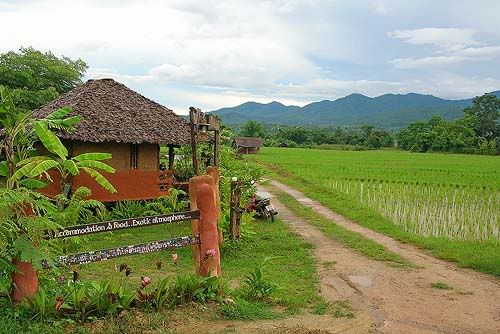
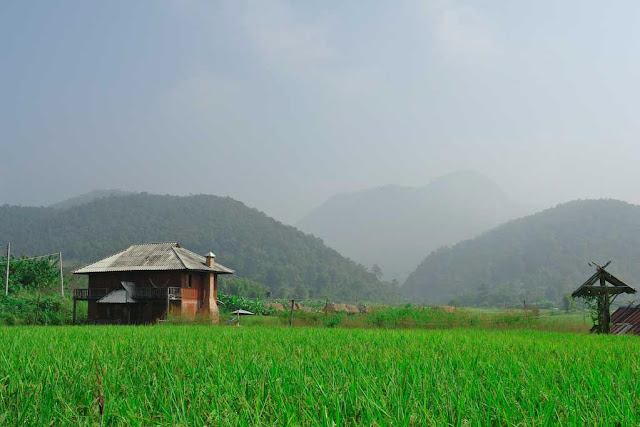
The sleepy hippie town of Pai is situated 135kms northwest of Chiang Mai, roughly halfway to Mae Hong Son. As you enter the Pai area, the mountain road makes a meandering decline into a large green valley of rice paddies and fruit groves. Mountains shelter the town, which is named after the river that runs through it. Pai is just a tiny place with four main roads, but offers a rich bohemian atmosphere where you can collect your thoughts and commune with nature. There are plenty of charming guesthouses, relaxed restaurants and bars catering to both Western and Thai palates, and local trekking companies and handcraft shops.

A decade ago, Pai was virtually unknown and it has today developed into a thriving, multi-cultural town. Fortunately, it has retained its down-to-earth feel and the prices here are still cheap, making it especially popular with backpackers and free-spirits who sometimes stay here for months.

Pai – Thailand Attractions
Lazy days in a hammock are a favourite in Pai, along with just staring out at the mountains or the river. However, you can make you way to the hot springs, which are well worth the effort. Nestled in a charming forest setting, about seven kilometres out of town, the springs are warm and relaxing, and a visit in the early morning is recommended.

Before you arrive at the hot springs, you will have passed the elephant camps, where you can ride one of these majestic creatures. One of the companies in operation here even offers bareback rides down the river, which is a unique experience that should not be missed.

Pai’s other natural attractions include a pretty if not too impressive waterfall and a canyon. The surrounding areas are stunning, especially during or just after the rainy season. White-water rafting on the Pai River is a favourite with adventure-seekers and some of the rapids are fairly breathtaking. For those looking for a more relaxing experience on the river, bamboo rafting and tubing on a gentler stretch of the river are fun alternatives.

Pai is also a superb base from which to trek into the surrounding mountains and visit hill tribes and other waterfalls. In season, there are two- to three-day treks departing daily to Karen, Lahu and Lisu villages. You can also obtain a local map for self-guided hikes to nearby waterfalls and caves. Massage and yoga are also good activities to pass the time in Pai, and a couple of permaculture farms offer places to hangout and learn about farming and building.

Those that want to do some sightseeing at temples can visit Wat Klang, next to the bus station. It has several small pagodas surrounding a central stupa. Also of interest are Wat Hodana and Wat Nam Hu, west of Route 1095. Wat Nam Hu is known for its Chiang Saen-era Buddha, whose hollow head is filled with holy water.

Pai is also a good stopover point on the popular Mae Hong Son loop. This three- to four-day self-drive/ride excursion takes you from Chiang Mai through the amazing mountain scenery to Mae Hong Son and back via Doi Inthanon national park. Along the way you can experience the beauty of Huay Nam Dang national park (before Pai), the caves at Soppong and numerous waterfalls.


From link::paithailand.chiangdao.com


Other links::Pai - Riverside Lodge
A Piece of Pai, A Slice of Heaven

Nina the Lone Explorer!

From link::by Christina Smith

Hi everyone!

We had a great time yesterday with our cookery class. It was just the two of us so we were happy that we wouldn't look like fools, especially me with not knowing what any vegetables are! First of all she took us to the market and showed us all the different ingredients and then we went to the kitchen and started preparing our masterpieces!

We chose to make spring rolls, pad thai, thai green curry, sweet and sour chicken and a coconut and chicken soup. We did really well and I think the pad thai was one of the best I have had, even if I do say so myself! There was only one funny incident when she told us to squeeze the limes into our soup and mum admitted that she had already thrown hers in the soup about 5 minutes ago. The teacher found it funny to point out that you don't usually boil limes as they are pretty bitter!

The spring rools were the most fun and we were very impressed with all our dishes. There will definately need to be a thai style party when we are both back. We were so stuffed afterwards that we couldn't eat another thing for the rest of the day.

That night we went to the night market and managed to resist buying anything which was good. We were knackered from a whole day of activities and the heat makes you so tired all the time so we just had some drinks back at the room and got totally sucked into watching braveheart until 12:30am even though we couldn't understand a word that the scottish people were saying!!

This morning we got a minibus for 4 hours to Pai (my fav town) and it has become mum's fave town too. Its a real hippy place and nobody bugs you to buy hings so we are very chilled out. It has actually rained a bit today which I have loved as it has meant the weather has cooled down loads. I might actually be able to wear my trousers today which is very exciting. Tomorrow we might be going for an elephant ride as long as we can find one that has a proper seat because mum won't go on it otherwise.

I'm thinking there might be some buckets tonight so keep an eye out on facebook for drunken pics!

Lots of love,

Neen and Julie xxxx

From link::by Christina Smith

Other links::Chiang Mai -water festival
So this is where all the other farang are

Pang Mapa, Thailand - Cave Lodge

From link::KB's travels


I decided to hire a scooter for a couple days and check out a remote area of northern Thailand. The woman at the rental shop only said, "hmmm... bring back the other bike and let me give you good bike." ha! Besides better brakes, the new Honda Icon actually had great features like a horn and an odometer, which came in handy when trying to figure out if the bunch of huts I just passed was actually the village I was trying to find. Also, several places have multiple names which resulted in some confusing fun! Before I set out I did some research on the condition of the local roads and used the "terrain" feature on google maps to ensure that the mountain roads weren't too steep. Riding steep downhills on a bike without gears is not my favorite thing to do.

Left Pai and traveled to Soppong, then continued north and ended up in Ban Tham. The ride was broken up by photo stops and waiting for herds of wandering cows to clear the road. The cows here all wear wooden cow bells and as a herd moves along they create a really pleasing, relaxing sound
stayed for three nights at Cave Lodge, a clustering of bungalows built by an eccentric Australian, John Spies, who traveled to Thailand 30 years ago and never left. John has spent his time here learning the hill tribe languages, photographing the tribes, and publishing articles about the area. He has also created detailed maps of the surrounding area, including hundreds of caves that hold 2000 year old carved teak coffins. Very little is known about these coffins and the people who placed them there. You can see some of his AMAZING tribal photographs here: http://www.cavelodge.com/tpics.htm He has also published an autobiographical account of his time in this region and its a fascinating read full of local history, politics, and archeology.

I stayed in the Ban Tham region three days. Did several hikes, visited some local hill tribes, and went into a couple caves. This area contains such a mix of people. The women working at the lodge spoke Shan, not Thai, and the local hill tribes speak yet another language. I paid some of the local villagers to guide me through various caves. The only English word one guide knew was "hello." He would point to a stalactite. "Hello." He would gesture down a dark tunnel. "Hello." Or he would wave good-bye. "Hello, hello."

From link::KB's travels

Other links::Pai, Thailand - The life of Pai
Chang Mai- Pai (Thailand)

Chiang Mai -water festival

From link::AsiaAdventure

After arriving back from Pattaya I was able to pick up my new passport several days later and promptly purchase myself a bus ticket for Chiang Mai, the main city in Northern Thailand where many of the big time thai massage schools exist. The overnight busride up took forever, about 12 hrs, and I had a horrible air conditioner vent streaming right down at my face the entire time. The bus was the cheapest way to get up to Chiang Mai, otherwise I would have taken a train, which I will probably do on the way back as they have beds on them. Also possible to take a airplane up north, but I didn't feel like paying the extra prices for.


Chiang Mai is an amazing city. Absolutely full of incredible and centuries old Buddhist temples with Buddhas of all sizes and styles inside. Many of the temples are quite rundown with crumbling brick formations and look like they have been around forever. Some are several hundred feet high with surreal looking Buddhas lodged halfway up on the side. It is very mesmerizing being around them and their sense of history. Also many Buddhist monks of all ages walking around in their orange robes. Was talking with a few of them and asking where some good monasteries to go meditate would be. Many options in Chiang Mai as well as throughout the country. Some of the western monks I was talking with have been living in the forest monasteries for 10 yrs or more.


I picked a great time to make it to Chiang Mai. The Thai New Year is celebrated each year from April 13 -15. The new year celebration is referred to as the Songkran Festival, sometimes called the Water Festival. Everybody is going crazy in the streets dumping buckets of water on everyone, hosing everyone, and squirting water on everyone who passes by, except for older folks and monks who are given upmost respect in the Thai community. This goes on for about 4 or 5 days and the main streets in the city are mayhem. It is a crazy party and everyone is drenched with water. There are big barrels of water filled up from hoses everyone dips into for water. Many times people dump large blocks of quickly thawing ice into them so that you get really cold water, the best water for dumping on people and really shocking them. I got a nice little squirt gun that is fun spraying into people's faces with. Lots of others got huge pump squirt guns that really blast water in your face and body. Pretty much everyone and all ages are involved, the little kids on up to middle aged and older folks. So cool seeing the excitement and exhilaration in the young kids faces as they are enjoying themselves. The busiest activity is on the roads along the water filled moat surrounding the square shaped old city portion of Chiang Mai. Here there is lots of fierce water battling between people on pick-up trucks cruising the streets and those on the sides.


I read somewhere that the dumping of water on everyone is a way of washing away bad luck for the year. Also a great way to cool down in the heat of the hot season in Thailand. The heat is not as bad up here as it is down in Bangkok. Bangkok was almost unbearable at times. Chiang Mai is so much more cleaner and peaceful. It has an amazing spiritual vibe about itself with all the temples, monks, thai massage schools, and healing centers throughout the city. The mountains and hill tribes are nearby and tons of opportunities for trekking are available.

Seen several elephants being walked around town during the evenings. It's amazing seeing how huge they are in person, standing over 10-15 ft high. Hopefully get a chance to ride one later on during a trek in the mtns.

From link::AsiaAdventure

Other links::
Pai, Thailand
Living with Lisu Hilltribe

So this is where all the other farang are

From link::www.travelpod.com

Arrived in Pai on Saturday the 18th, a 4 hour bus ride east of Mae Hong Son. It turns out the reason I hadn't been seeing that many tourists in Thailand is because they all came here, and decided to stay. Pai seems to have more tourists than locals, although obviously this is partly due to me spending my time in the tourist areas too. It was a very small, laid back hippie town a few decades ago, but now there are shops and tours to meet every tourist desire, and American, Mexican, and Italian restauants, among many others. Pai also seems to be afflicted by the same maladies as many a beach town around the world, by which I mean reggae, tatoo parlors, and lots of white people with dreadlocks. Nothng necessarily wrong with any of this, it's just all not very Thai. And when I say reggae, I mostly mean soft-rock/folky covers of Bob Marley songs. Ew.
1.8. Rice Fields, Pai, Thailand

Anyway, like most travelers who make it here, I stuck around for a few days. The pull of the familar is difficult to resist. I rented a motorbike for the first time in Thailand, and explored the countryside for a day. Passed through hill tribe villages (much more modern ones than the one I visited), fed an elephant a banana at an "elephant camp", visited Pai Canyon (not terribly grand), saw another waterfall, and later that evening took a swim in a hot spring pool. A great day all around, and learning how to ride the motorbike proved very easy.


Hung around Pai for two more days after this, doing some internet stuff, reading and generally being lazy. Also went to the local pool (of the non hot spring variety), for an afternoon. One of the other things that made Pai such a compelling place to hang around in was that they have a few places where you can rent DVDs and watch them in rented rooms. I couldn't resist taking advantage, as I have been experiencing severe movie withdrawal, so I rented a movie one evening at Cinema Paradiso. You couldn't find it if you searched all the Blockbusters in America, but this small northern thai town had Eurmir Kusterica's Underground. So now I miss movies even more, but I'll just have to get over it.


The only other notable occurance of my time in Pai was the discovery of a tick on top of my head. Probbaly picked it up treking. My head had been sore but I thought at first that it was just the result of bumping my head on one too many small doorways. The woman who ran the guesthouse was very grossed out by this and said it had probably been there for about three days based on its size. They pulled it out for me and put some iodine on the spot to disinfect it. Still a bit sore now. Lucky for me the doxycycline I'm taking as malaria prevention also protects me from whatever disease that little tick might have wanted to infect me with. Having dealt with my first medical issue, I packed up and headed a few more hours southeast.

From link::www.travelpod.com

Other links::
A Piece of Pai, A Slice of Heaven

Blogged with the Flock Browser

A Piece of Pai, A Slice of Heaven

From link::www.travelpod.com

A piece of Pai, is like a slice of heaven tucked in between lush green jungled mountains in the North West of Thailand. Pai means "bye" in Thai, which is kind of ironic because once no one seems to go anywhere once they arrive here. A traveler once wrote that "Pai is the kind of place I'd be inclined to despise if there wasn't so much that I liked here." Pai is nothing more than a tic-tac-toe of small streets making up a small village hidden amongst mountains that has become disgustingly overrun with tourists through the years. Generally speaking, I avoid places that are overrun with tourists, and wherever my travel guide book tells me to go, I go the opposite direction. But, after a month of Asia, this refreshing "farang" retreat was just what I needed.

The road from Chaing Mai to Pai offers beautiful views of densely forested mountains and plenty of opportunities to put your face in a barf bag. Constructed by the Japanese during WWII, the road curves and winds its way through jungle passes. Busses struggle to climb the steep upgrades, gears cranking and pistons screaming, tires nearly slide off the edges of the cliffs on 300 degree turns or come to a screeching halt in avoidance of cows roaming in herds. But, once you descend from the mountains, and your stomach settles upon arrival in this quaint village, you quickly come to say, "I love this place!"

Streets are lined with the typical Thai tourist attractions of river rafting and hill trekking, but more so attractive are the local hill tribes-women weaving purses and hats in brilliantly vibrant colors. Bakeries and restaurants galore offer international cuisine and coffee and internet shops offer a chance to retouch with those back home. The towns' aroma is a pleasant mixture of patchouli oil and Thai curry. Just outside town offers chances to relax in hot springs or visit waterfalls. But more than what this town offers to travelers, is its feeling and spirit which makes it so enchanting.


We settled into Villa de Pai, a lackadaisical little village of straw thatched roof bungalows with outdoor bathrooms on the banks of the muddy, racing Pai River. We arrived the night after a major flood and were welcomed to our bungalow with mud up to our mid-calves. At first, this was a deterrent, but quickly the mud became fun, shoeless we trudged through the area meeting many Israelis on holiday. I quickly re-named the Villa de Pai, the Gaza Strip, and once again felt like a minority. Villa de Pai became a picturesque community of backpackers, strumming guitars, smoking hand rolled cigarettes whilst sharing travel stories and watching the river pass by from our patios. On Sunday evening, a few of the men organized and prepared a community BBQ with fresh meats and vegetables, whisky and beer, and we all gathered around to eat and drink until the wee hours of the morning. It felt like living on a kibbutz.


Always the adventure seeker in me, I had the chance to learn to river kayak down the Pai River. It was my first time kayaking in a river and it was a rush to say the least. An intricate and almost sensual balance of body weight and positioning, I quickly picked-up the basics and off I went down the small rapids. I managed the small rapids while managing not to tip over which brought on cheers of praise from my friends on near-by kayaks. The river flows through the jungles offering stunning views of the outlaying mountains and bamboo huts along the banks. The low laying clouds sit atop the mountains as sprinkles of rain softly land adding to the force of the river flow.

From link::www.travelpod.com

Other links::Pai - Riverside Lodge
Pai, Thailand01

5/02/2008

Pai - Riverside Lodge

From link::www.travelpod.com

After leaving the bitter taste in my mouth from seeing what Chiang Mai had become, I took one of the luxuries of tourist hell traps that I enjoy, expensive door to door tourist minivans, to Pai. On the bus, I met an American from of all places Lincoln, Nebraska. I've been a lot of places around the world and besides Dano, Mark is the only other Nebraskan that I've seen outside of Nebraska. I spent about an hour looking for a nice place 2 chill out before I gave up and just rented motorbikes to cruise around the beautiful valleys and hills around Pai.

I did find a beautiful serene place on the river, Pai River Lodge, but it was full.


I could tell that the vibe was exactly what I wanted tho when no one greeted me and I had to look around to find a long haired hippy Thai dude, to tell me, "dunno, maybe check back tomorrow". He sorta personified Pai's feel of a very chilled out little hippy haven. It's a picturesque little town in the north of Thailand about 20K from the Burmese border set alongside a small river encircled by mountains. The main part of town is basically 2x2 streets with roads leading off to other villages nearby. Unfortunately, but of course, all the best bars are a bit out of town and quite a hike to get to without a motor bike. We decided to head to a nearby hot spring for a dip. What we didn't know was when they say HOT springs, they mean it! The water temperature was 80C or 176F, hot enough to boil eggs (for reference, hot tubs are usually set around 103F). Glad there were some guys around to tell us that because there certainly weren't any signs.
We stopped at Unicorn, a great little restaurant in the valley, for lunch and a couple beers. You can't beat 25B/ dish. Unfortunately, after we ate I stepped off the bamboo platform directly onto the proverbial rusty nail. OUCH! This pretty much defined what I was gonna do in Pai as the T-shirts say, "Do nothing in Pai". I went to the hospital and got my wound cleaned, a tetanus booster and a course of antibiotics for the mere price of 267 not dollars, but Baht, around $7.50. The rest of the time in Pai, I spent pretty much chillin on my hammock and eating.

From link::www.travelpod.com

Other links::A Piece of Pai, A Slice of Heaven
More Wildlife Wanderings in Pai

Canyon Land in Pai, Thailand

From link::Canyon Land in Pai, Thailand


These are pics we took one day while hiking around the outskirts of Pai in the northern part of Thailand.


Beautiful Sunset!


This trail is really fun. On either side are steep, 100 foot drop offs.

From link::Canyon Land in Pai, Thailand
Other links::Pai - Riverside Lodge

Pai, Thailand02

<<Pai, Thailand01

Link::From Wikipedia, the free encyclopedia

Flood of 2005

Pai suffered a huge mudslide and severe flooding in 2005, resulting in major structural damage to homes, resorts, storefronts, and bridges. The town had almost completely recovered by the time the 2006 high season began.

Controversy over Police Conduct

Although it is a sleepy town in the mountains, Pai has over the past decade generated an unusual amount of controversy (even for Thailand) concerning the conduct of its local police, as well as the conduct of Thai drug enforcement police operating there. This is partially due to the proximity of Pai to drug routes from the Shan State in Burma, however given the post-2000 rise in incidents involving foreign tourists, it is evident that other factors are also at work. Some examples of this clear long-term trend in Pai include:

  • On December 24th, 2001, the local Pai police arrested and jailed the owner of Bebop bar, with the rather dubious explanation that he was "letting people dance in a place of business not officially licensed as a ‘disco.’"[7] After this event, both Bebob and Mountain Blue received additional discriminatory treatment in the form of illegal, or uneven, application of Thailand's closing-time laws. The so-called "dancing ban" by the Thai Police became a famous and well-known joke which business owners are still talking about in 2008.
  • Also in 2001, and again in 2003, Pai district officials and police began enforcing several illegal measures ostensibly aimed at increasing "safety" for the local tourists, specifically "a ‘recommendation’ via illegal denial of permits whereby all guesthouses must have walls made from a solid material, such as wood, gypsum, compressed fibre or cement"[8] rather than the cheaper and more traditional bamboo favored by many guesthouse owners and low-budget backpackers. Most locals suspected other motives were involved, including both a desire to "weed out" low-budget tourists and to encourage higher-priced construction that would generate higher construction kickbacks. Several locals pointed out uneven enforcement of these laws for different businesses, depending on personal relationships with the police or district officials.
  • The so-called "War on Drugs" launched in February 2003 by former (now deposed) Prime Minister Thaksin Shinawatra, in which "more than 2,000 people in Thailand were killed as the government effectively declared 'open season' on those accused of involvement in the drug trade,"[9], took a heavy toll on Pai district and downtown Pai in particular. Many locals whose family members were murdered without investigation now take an extremely skeptical view towards any police action here.[10]
  • In 2006, the Pai Police purchased a new mobile drug testing vehicle, and there have been numerous reported instances of the police entering bars and other establishments and randomly urine-testing foreign tourists. In many of these cases it is apparent that the searches were not performed legally. In Thailand, "when requesting urinalysis for drug identification purposes, at least one member of the Narcotics Suppression Police must be present. Regular Thai police do not have this right, nor do the Tourist Police. Second of all, there must be probable cause."[11]. In most cases, apprehended suspects are detained in Mae Hong Son jail for a few days, then released with a "fine" typically on the order of 5,000-10,000 baht.[12]
  • On January 5th 2008, Pai made national and international news when an off-duty police officer, Sgt-Major Uthai Dechawiwat, fatally shot Canadian tourist John Leo Del Pinto, and shot and wounded a second Canadian tourist Carly Reisig, fleeing the scene immediately after the event.[13][14] Nearly all involved believe that both the policeman and suspects were drunk at the time. Official police reports differ widely from eye-witness reports and it is expected that the officer will be acquitted by the Thai Justice system. In an extremely unusual development which highlights the deep integrity issues that exist with the Pai police, reporter Andrew Drummond published an editorial in The Nation where he expressed his regrets for publishing views from all sides of the story in his earlier Nation article because:

    "While the facts presented were true, they have been wrongly taken in a malicious way by many...What the journalist cannot convey sometimes is his opinion of whether the witnesses are telling the truth or show immediately what links these witnesses have to the police....I am very concerned at several aspects of this case:

    1. The police claiming that Reisig was pregnant and this had angered a jealous foreign boyfriend.
    2. The claims by the police shooter that he had been out of town before the shooting, when other witnesses were saying the officer was drinking heavily that night in Pai.
    3. The threats to prosecute Reisig for assault on police.
    4. The automatic bail for the police gunman.
    5. The fact that local police are investigating themselves.
    6. The claims that the gun had discharged three times accidentally."
  • In a January, 2008 editorial published in Chiang Mai CityLife (submitted in December, 2007),anonymous author "A Tourist" eerily anticipates the January, 2008 shooting in his/her strongly-worded objection to excessive police actions in Pai:

    "I have noticed another significant change over the last year, which is the reason for writing this letter. The method of law enforcement in this small town needs to be seriously examined....I accept that changes are necessary. I also agree that noise pollution should be carefully monitored and controlled, as should drug abuse and any other illegal acts or unpleasant kinds of behaviour, but we ought not to be scared to leave our homes (or guesthouses)! ... One Saturday in particular remains in my memory, where several police officers decided to inspect a party at a bar in town. I believe that they were looking for drugs. I along with many other tourists was especially shocked to see that one officer was carrying a machine gun...This kind of behaviour is likely to scare tourists and leave very negative impressions on them with regards to Pai town as a holiday destination...The police are also actively confiscating other vehicles, testing individuals at random for drugs and alcohol abuse, detaining owners of restaurants and bars for remaining open past the agreed time, and generally making a lot of noise in a relatively quiet town that did not appear to have many problems beforehand....The increased police presence is clearly visible and does not, in my opinion, make Pai town look like a place one would like to visit. There is also a general feeling of unrest here and I feel that it is quite obvious to the tourist travelling through. The police are unapproachable and menacing. This has a strong negative impact on the atmosphere here in Pai town. The previously friendly and welcoming town appears to have changed into a place where everyone is afraid to even walk down the street in case they are accused of doing something wrong. Should the police not be employed to protect civilians? Should they not be approachable in case I or someone else requires some help? They are certainly not even close to doing what a police force is meant to do."

Link::From Wikipedia, the free encyclopedia

Pai, Thailand01

Link::From Wikipedia, the free encyclopedia

Pai (Thai: ปาย) is a small town in northern Thailand near the Myanmar border, north of Chiang Mai on the northern route to Mae Hong Son. It lies along the Pai River. The town has thesaban tambon status and covers parts of the tambon Wiang Tai of Pai district। As of 2006 it has a population of 2,284

Access

Pai is located on Thai highway 1095, which connects Mae Hong Son with Chiang Mai. The Pai Airport, which had been decommissioned for 20 years, was paved and refurbished in 2005-6, and on 1 February 2007, Siam General Aviation began daily passenger service to and from Chiang Mai International Airport.

Tourism and Development

Pai was once a quiet market village inhabited by Shan people (ethnic Tai whose culture is influenced by Burma; see the History section below), but nowadays Pai primarily thrives on tourism. Well-known among backpackers for its relaxed atmosphere, the town is full of cheap guesthouses, souvenir shops and restaurants. In the proximity of the town are spas and elephant camps. Further outside of town, there are several waterfalls and a number of natural hot springs varying in temperature from 80 to 200 degrees Celsius. Some resorts tap the hot springs and feed hot water into private bungalows and public pools. As Pai lies at the foot of the mountains, many tourists use it as a base for trekking and visiting hill tribes like Karen, Hmong, Lisu and Lahu. Another notable attraction is the town's excellent Wednesday Market which brings large and colorful crowds of local villagers and tribal people from all around the Pai Valley.

Recently Pai has appeared on the Thailand tourist map and has received major infrastructure upgrades including an airport with several daily flights, two 7/11's, several small- to medium-size luxury resorts (adding to the more than 118 guesthouses and restaurants which existed as of June 2007[2]), a couple of live music clubs, beer bars and two sets of traffic lights. This has done little to dampen the small and peaceful spirit of the town out of season. However, it has led to a recent influx of business investment and land speculation by both farang (non-Asian foreigners) and big city Thais. While some hail these sweeping changes as a new age of prosperity for Pai, others point to the loss of Pai's traditional customs and culture.[3][4]

In the tourist high season of November through March there are large numbers of tourists. Prior to 2006, foreign tourists predominated, but now Thai tourists make up the vast majority, particularly after Pai featured in two popular, Thai-made romantic movies, The Letter: Jod Mai Rak (Thai: จดหมายรัก, 2004) and Ruk Jung (Thai: รักจัง, 2006).

Pai has music festivals regularly as well as staging an International Enduro Championship।

History

Unless otherwise indicated, the information in this section is based on local Pai resident Thomas Kasper's history of Pai:

The area of modern-day Pai has been inhabited for more than 5,000 years. About 2,000 years ago, the Lua (or Lawa) Tribe was the dominant ethnic group all over the area of today's northern Thailand, and a few of their descendants still live in villages only about 20km away from Pai.

The recorded history of the area starts about 800 years ago with the establishment of a settlement (today known as Ban Wiang Nuea) about 3km north of modern-day Pai. Ban Wiang Nuea was founded in 1251 AD by Shan immigrants from the region of modern-day northern Burma. Due to the area's remoteness and seclusion, people in those times were mainly cut off from news of the outside world and therefore not much concerned with the politics of Lanna and the rest of Thailand. That changed drastically in the course of the 14th and 15th century, when the first settlers arrived from Chiang Mai. It was part of Lanna policy of the time to send citizens loyal to the Lanna throne to the outposts of the empire, in order to consolidate and affirm Lanna's territorial authority। The result was a conflict that eventually led to a series of wars over territorial dominance in the Pai area. The Lanna troops finally defeated the Shan soldiers in 1481, forcing them to retire to Burmese territory. The Shan families who had lived in the area for a long time, establishing households, farming their land and raising their families, were granted permission to stay by the Lanna prince, along with a certain degree of cultural and social autonomy under the law and authority of the Lanna kingdom. Ban Wiang Nuea as a result became a village sharply divided into two parts by a wall into a "Shan" part and a "Lanna" part.

In the second half of the 19th century, colonial powers France and England, who had already established their influence in Vietnam, Cambodia, Laos and Burma, were viewing the area of modern-day Thailand with increasing interest. To consolidate Siam's influence and authority in the northern border region, the royal house encouraged Northern Thais from provinces like Payao, Lamphun and Nan to migrate to those areas. The result again was conflict: the last fight between Lanna Thai and Shan in Ban Wiang Nuea took place in 1869, when Lanna soldiers finally defeated their Shan opponents in a battle that ended with the total destruction of the village. The entire village was burnt to the ground. All structures standing in Ban Vieng Nuea today are the result of the subsequent rebuilding efforts of the villagers.

There was already a "road" (that took up to a week to traverse) leading from Chiang Mai to Pai in the late 19th century. Many of the new immigrants chose to settle in the area of the connecting road to Mae Hong Son, south of the village of Ban Wiang Nuea. This settlement was known as Ban Wiang Tai, and it developed into the modern town we know as Pai.

During World War Two, the Japanese began several projects to create efficient troop and equipment transport routes between Thailand and Burma, and (in addition to the well-known Death Railway through Kanchanaburi) one of these projects was the improvement of the existing "road" from Chiang Mai through Pai and Mae Hong Son. A wood and steel bridge built by the Japanese still stands about 10 km from Pai on the road to Chiang Mai, just parallel to the bridge later built in the course of more recent road improvement projects by the Thai government. As it turned out, just about when the Japanese supply line reached Burma, the war was over.

The Thai government started developing the road leading from Chiang Mai via Pai to Mae Hong Son, known today as Highway 1095, in 1967, but didn't finish paving the route until the early- to mid-1990s।

Pai's recent history is one of waves of migration: in addition to the aforementioned waves of old Shan and Lanna immigrants, Karen immigrants arrived in the 18th century, Lisu and Lahu people from areas of southern China arrived in the early 20th century, Muslim families from Chiang Mai began arriving to establish trade businesses starting around 1950, a group of Kuomintang fleeing Mao Zedong established a community in Pai in the early 1960s, and finally a new wave of refugees from the Shan State of Burma have arrived in the last few decades, fleeing the turmoil caused by the Burmese Junta to work as laborers in Thailand।

Link::From Wikipedia, the free encyclopedia

Other links::
Pai, Thailand02
Canyon Land in Pai, Thailand